sexta-feira, 7 de janeiro de 2011

Existence by Schopenhauer

Of every event in our life it is only for a moment that we can say that it is; after that we must say for ever that it was. What has been exists no more; and exists just as little as that which has never been. But everything that exists has been in the next moment. Hence something belonging to the present, however unimportant it may be, is superior to something important belonging to the past; this is because the former is a reality and related to the latter as something is to nothing. Our existence is based solely on the ever-fleeting present.


The scenes of our life are like pictures in a rough mosaic, which have no effect at close quarters, but must be looked at from a distance in order to discern their beauty. So that to obtain something we have desired is to find out that it is worthless; we are always living in expectation of better things, while, at the same time, we often repent and long for things that belong to the past.We accept the present as a means to accomplish our aim.


That human life must be a kind of mistake is sufficiently clear from the fact that man is a compound of needs, which are dificult to satisfy; moreover, if they are satisfied, all he is granted is a state of painlessness, in which he can only give himself up to boredom. This is a precise proof that existence in itself has no value, since boredom is meerly the feeling of the emptiness of life. Our existance would  not be a joyous thing unless we were striving after something; distance and obstacles to be overcome then represent our aim as something that would satisfy us - and illusion which vanishes when our aim has been attained. So that the first task is to win something, and the second, after the something has been won, it is time to forget about it, otherwise it becomes a burden.


Time is an element in our brain which by the means of duration gives us a semblance of reality to the absolutely empty existence of things and ourselves.


segunda-feira, 3 de janeiro de 2011

Amnesia: The Dark Descent

There is one emotional state that I've never felt in a game - fear. Constant, gripping fear. Ask yourself, have you ever felt truly afraid in a game? Have you ever felt for yourself the imminent danger that the player character is supposed to be feeling? I can't say I ever have.

Until now.


The player takes the role of Daniel, the main character who wakes up in a dark castle with no memory of who he is or why he's there. That's the entire setup, and the simplicity of this concept lends itself brilliantly to the sense of isolation that Amnesia conveys so well.

When you run the game for the first time Amnesia gives a few statements as to how this game works:
-You have no access to weapons during the entire game, you must use your wits to avoid or hide from enemies.
-Don't stay in the dark for too long. Staying in the dark reduces your sanity.
-This game is meant to be played alone in a dark room. Turn the lights off and put headphones on.


Amnesia creates the best atmosphere I've ever seen in a videogame. The wonderfully disturbing castle combined with subtle visual and audio effects are seamlessly woven together to create something terrifying on a level I've never experienced before. On top of the aesthetic, the structure of play is designed to ensure that the player is always on edge since there is absolutely no fighting back against the various enemies encountered. This prohibition on combat creates a sense of helplessness that challenges every video game instinct I've had burned into my psyche.

You see, the first thing any gamer thinks when encountering an adversary is, "how do I kill it?"
That is the lesson we've had pounded into us. No matter what, the player always has some kind of weapon to use against the bad guys. Even in 'stealth' games there's usually a way to take out or at least avoid a given enemy. We're always in a position of power, to a certain degree.

Amnesia is different. The player is completely defenseless against the horrors of the castle. My only recourse when encountering a scary-looking thing was to literally run and hide, and hope that they would go away. 
The first time I actually encountered a monster, I ran and I hid. I wasn't thinking about killing it, I didnt look back to see what he looks like, I wasn't thinking about getting out of its line of sight, and I wasn't even thinking about how to get past it. I wanted to stay in my hiding spot in the dark where I felt safe. There was no thought other than "please just make him go away" crossing my mind. I could hear it getting closer every now and then, and sitting in the dark caused my character's sanity level to slowly drop, which in turn caused the screen to distort and cue disturbing sound effects.


That, my friends, is fear, and Amnesia is a game that invokes it like no other. The imagination is capable of dreaming up things that are more terrifying than anything conjured up on a screen, and Amnesia does an excellent job of screwing the player's imagination to a point where it exists in a constant state of abject terror.


Of course, that's not to say that hiding from some shambling monstrosity is all that Amnesia has to offer. The story and structure are brilliantly realized.  The story is fascinating and is told through easily digested chunks scattered through the game.  Read everything you find, and you'll be drawn into a chilling castle populated by a lone protagonist who is a bit off his nut and being hunted by shadowy somethings that are more than a teensy bit spine-chilling. Hints are also provided by flashbacks that regularly pop up out of nowhere.


Amnesia: The Dark Descent is undoubtedly going to take a place among the most frightening horror games ever made. It is a touch short, although you can't gripe too much about that given the cheap 15 euros price tag as an online download.

segunda-feira, 29 de novembro de 2010

Creepy places... On the Internet

The Internet is enormous. And given that it has, up to this point, been almost completely anonymous it's not surprising there are some pretty strange parts. So it takes a mind-bending, almost admirable level of dedication to stand out among the tangle of crazy. There are several websites that prove the internet can still make the hairs on the back of your neck stand on end ...


You can find an Internet forum for pretty much anything. So at first glance, The Bloody Board, a forum for fans of Buffy the Vampire Slayer (famous tv series that I personally dislike with great intensity by the way), seems comfortingly normal. They post tweets from former cast members of the show (mostly about how much it sucks to work at this gas station now), speculate about plot points, discuss favorite episodes and fan art; the usual stuff.

But on close inspection, something's just a little off ...


One user, "jamie_marsters" appears to be quite prolific, posting and replying many, many times a day. We suppose it's sort of creepy that she's taken the name of Buffy star James Marsters, and changed it to Jamie to imply familiarity, like an ex-girlfriend or an old babysitter might.

A quick look at the profile statistics and things get much worse. Look at the number of total posts "jamie" has made....


That's right, almost 40,000 posts. 


The only problem is......


There is no community. There is only jamie_marsters. Scrolling through the archives reveals that there are virtually no other users, just this one, posting non stop, replying to herself, over and over again, almost every minute of every day for the last six years, alone inside her own dark little chamber of madness...


1 month ago, after 6 whole years  "jamie_marsters" deleted the forum, after this story was released and the website was overrun by internet trolls.

terça-feira, 23 de novembro de 2010

Låt den rätte komma in


Anybody who was depressed, bored or annoyed at the chaste cheesyness of Twilight is going to have their faith restored in the power of vampire mythology when they see the intriguing Swedish horror drama Låt den rätte komma in (Let the Right One In). Directed by Tomas Alfredson and based on the novel by John Ajvide Lindqvist, who also wrote the film’s screenplay, Let the Right One In is about the friendship between Oskar, a lonely and bullied twelve-year-old boy, and Eli, the strange girl who moves into the same apartment block as Oskar in suburban Stockholm. It is reminiscent of Brian de Palma’s classic Carrie but far more understated. This beautiful film balances brief moments of horror with a genuinely touching story about first love and coming of age.
Like Pan's Labyrinth, Let the Right One In is both a beautiful, inventive horror film and a touching study of tormented adolescence. The director employs just enough gore to please genre fans, offering a memorable ending that's earned him comparisons to Kubrick.


 Oskar spends his days playing out revenge fantasies he will never enact


Refreshingly free of over explanatory dialogue or the need to spell things out to the audience, Let the Right One In is a subtle film but not an obscure one. Moments of gore are discrete and integrated into the film without ever feeling exploitive. In fact all acts of violence are so brief and artfully depicted that they create an impact that lingers long in the mind while taking up hardly any screen time. Let the Right One In is a slow burning film with an engulfing atmosphere that leaves you feeling moved and mesmerised long after the credits have finished.


Naturally, it’s being remade in America. See it before Hollywood sinks its fangs in and turns it into one of its own.

quinta-feira, 11 de novembro de 2010

Creepy places you can actually vist (part 2)

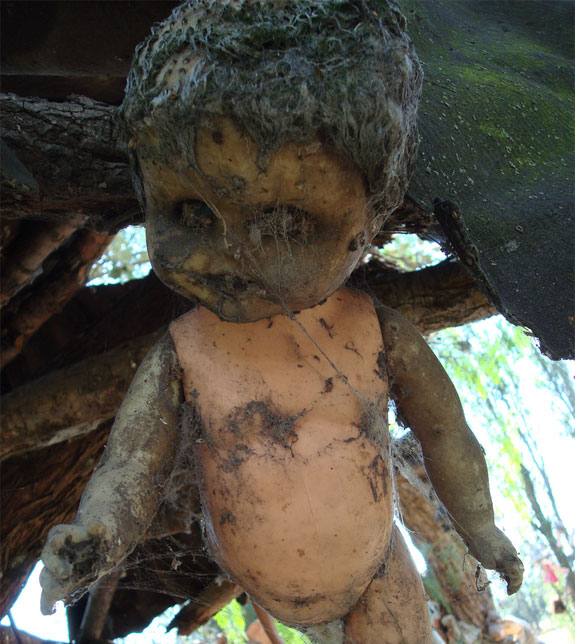
In the middle of a swamp in the heart of Aztec country is the popular tourist destination La Isla de las Munecas, or Island of the Dolls.
To get there, visitors have to hire a guide to take them by boat through the canals of Xochimilco, then to the island itself, all the while making the guide promise on a stack of Bibles that he's not going to abandon them once they reach their destination.

"Seriously, Pablo? We will haunt your ass."


Not that he'd do that, right? It's just an old abandoned island, once occupied by a single inhabitant named Don Julian Santana Barrera, who seemed to have a thing for doll-collecting. So what? Lots of people collect dolls.


Charming.


The legend goes that years ago a small girl drowned in the canals near the island, and not long after her death, Barrera found her corpse doll floating in the water. Then he found another one. By that point he was hooked on a new and exciting hobby.
Over the course of the next 50 years, the guy collected thousands of discarded dolls, which he thought would somehow serve as companions for the dead girl.
Makes sense. Everyone knows Mexican girls enjoy mutilated trash dolls displayed in gruesome manners meant to simulate acts of torture and suicide. We try not to be too judgmental about other people's cultures.
However, it does seem that the offerings weren't such a success, considering that in 2001 Julian passed away ... by drowning in the same canal as the girl whose ghost he was trying to appease for all those years. 
Either that or he was murdered, Chucky-style, by his horrific collection, who then dragged him to the canals to make it look like a drowning.

quarta-feira, 10 de novembro de 2010

Creepy places you can actually vist (part 1)

Whether it's due to their bizarre histories, suspicious coincidences or good old human insanity, these are the locations even the die-hardest of atheists wouldn't venture into without a crucifix and a Super Soaker full of Pope-blessed water.

I'll start with one that comes directly from my very own Portugal.

The chapel was in fact the work of a single 16th-century Franciscan monk who wanted to make his fellow Christians contemplate the transitory nature of life.


The entrance is marked with "We bones, lying here, for yours we wait."


In addition to cementing human bones in its walls, proudly exhibits two full skeletons (one of a small child) suspended on chains